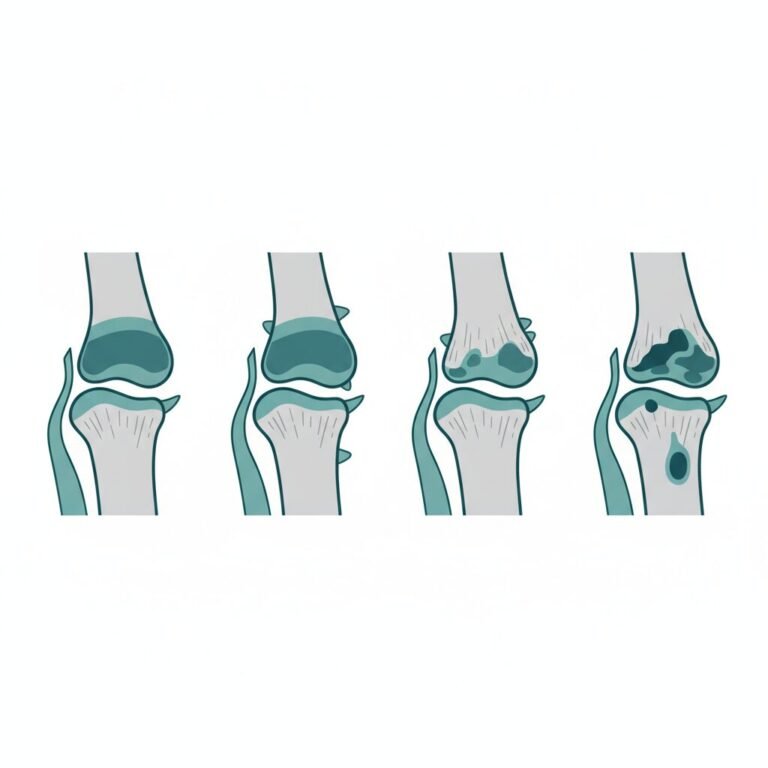
If you have pain at the base of your thumb, you might wonder what is happening inside your hand. A study from 1983 found something surprising. Researchers discovered a connection between a small bone spur in your hand and thumb arthritis.
This article explains what the study found. You will learn about bone spurs, ligaments, and why your thumb might hurt.
Here are three key points:
- A bone spur can grow on a bone in your hand near your thumb.
- This bone spur can change how a ligament works.
- When the ligament stops working well, your thumb can move out of place and develop arthritis.
Key Findings at a Glance
- Research shows a direct link between a bone spur on the second metacarpal bone and thumb arthritis.
- The thumb bone connects to the second metacarpal bone through a ligament, which is like a strong rope inside your hand.
- High pulling forces stretch the ligament over time, causing parts of it to turn into bone.
- When the ligament becomes stiff and bony, it loses its ability to hold the thumb in place.
- The thumb then shifts out of position, leading to arthritis at the base of the thumb.
What Did This Study Find?
According to this study, researchers proved a cause and effect relationship. They found that a bone spur growing on one of your hand bones can lead to thumb arthritis.
You may be wondering why this matters.
Understanding the cause helps doctors and patients make sense of thumb pain. It also shows that what happens in one part of your hand can affect your thumb.
What Is a Bone Spur and Where Is It?
A bone spur is a small piece of extra bone that grows where it should not. Think of it like a bump that forms on a bone.
In this study, the bone spur grows on the second metacarpal bone. This bone is in your hand. It sits right next to your thumb bone.
Your thumb bone is connected to this second metacarpal bone by a ligament. A ligament is like a strong rope made of tissue. It holds bones together and keeps them in the right position.
How Does the Ligament Change?
Here is where it gets interesting.
According to this study, when you use your hand, strong pulling forces stretch the ligament. Over time, these pulling forces become too much. The ligament starts to stretch and get longer.
Research shows that when the ligament is pulled too hard for too long, something unusual happens. Parts of the ligament begin to turn into bone. This process is called ossification. It means soft tissue becomes hard like bone.
When the ligament becomes partly bone, it loses its flexibility. It can no longer work like a rope. It becomes stiff.
Why Does the Ligament Lose Its Job?
The ligament has an important job. It holds your thumb bone in the right place. But when part of it turns into bone, it cannot do this job anymore.
Think of it like a rubber band that turns into a stick. It can no longer stretch or hold things together properly.
Why Does Your Thumb Move Out of Place?
Once the ligament stops working, your thumb is no longer held tightly in position. The study found that the thumb begins to shift. It moves toward the side of your hand where your radius bone is. The radius is one of the two bones in your forearm. It is on the thumb side.
This shift is called subluxation. It means the bone moves partly out of its normal position in the joint.
When your thumb shifts out of place, the joint surfaces no longer fit together well. They rub against each other in the wrong way. Over time, this rubbing wears down the joint. That wearing down is arthritis.
Let Us Look Closer
The researchers in this study proved that the bone spur, the ligament change, and the thumb shift are all connected. One leads to the next.
This chain of events helps explain why some people develop thumb arthritis. It is not just bad luck. There is a physical reason inside the hand.
Frequently Asked Questions
Can I feel a bone spur in my hand?
Most people cannot feel a bone spur on the second metacarpal bone from the outside. It is small and deep inside your hand. A doctor can see it on an X-ray.
Does everyone with a bone spur get thumb arthritis?
The study shows a connection, but it does not say that every person with a bone spur will get thumb arthritis. It does show that the bone spur plays a role in causing the arthritis in some people.
Can the ligament heal once it turns into bone?
Once a ligament has partly turned into bone, that change is permanent. The bone does not turn back into soft ligament tissue. This is why early care and support for your thumb can be important.
What should I do if I have thumb pain?
If you have pain at the base of your thumb, it is a good idea to see a doctor. They can take an X-ray and check for bone spurs, joint changes, and arthritis. Knowing what is happening inside your hand helps you and your doctor make the best plan for your care.
What This Means for You
This study gives us a clearer picture of how thumb arthritis can start. It shows that a bone spur on a nearby hand bone can set off a chain of events. The ligament changes, loses its strength, and your thumb moves out of place. That movement leads to arthritis.
Understanding this process can help you feel less confused about your pain. It also reminds us that our hand bones, ligaments, and joints all work together. When one part has trouble, it can affect another.
If you are living with thumb pain, you are not alone. Many people experience this. Knowing the science behind it is a step toward finding the right care.
About This Site
We simplify medical science for people with thumb pain and rhizarthrosis. Every article is based only on published scientific research. Our goal is to help you understand what studies say, in plain language. We invite you to explore more articles and learn about your thumb health.
Disclaimer
This article is for educational purposes only. It is not medical advice. If you have thumb pain or any health concern, please talk to a doctor or healthcare provider. They can give you advice that fits your specific situation.
Scientific Source
Koebke, J., Thomas, W., & Winter, H. J. (1983). The significance of bone spurs at the base of the 2d metacarpal bone in the pathogenesis of joint arthrosis of the base of the thumb. Z Orthop Ihre Grenzgeb.
https://doi.org/10.1055/s-2008-1051324
Now that you understand the anatomy, learn how rhizarthrosis is diagnosed and what the Eaton stages mean.
Diagnosis Guide